
Hamden Parole vs Probation
Connecticut divides Hamden County post-release supervision by legal source. The Connecticut Board of Pardons and Paroles decides parole matters, while the Department of Correction Parole and Community Services Division oversees parole in the community. Probation is ordered by a court and administered through the Judicial Branch Court Support Services Division. That split determines where to look.
A Hamden arrest can end in probation without a state prison term. By contrast, parole follows a prison sentence and a Board decision. Special parole is also a court-imposed part of some sentences, but DOC and the Board handle its supervision and revocation framework. An old Hamden Police arrest log does not prove that any form of supervision is still active.
| Point | Parole | Probation |
|---|---|---|
| Legal source | Release from a prison sentence under Board authority | A sentence or condition imposed by the court |
| Main public trail | CT DOC status, BOPP hearing information, and Board contacts | Judicial Branch docket, conviction record, and probation contacts |
| Custody history | Usually follows DOC incarceration | Can begin without a lengthy prison stay |
| Possible end | Discharge, expiration, early termination, or revocation | Completion, court discharge, modification, or revocation |
Definitions help keep the records straight.
- Parole
- Conditional release from a prison term while supervision continues in the community.
- Probation
- Court-ordered community supervision that may be imposed instead of, or after, custody.
- Special parole
- A court-ordered supervision term administered in Connecticut's parole system.
- Discharge
- The formal end of custody or supervision, not merely departure from a facility.
Verify Hamden Post-Release Supervision
No single Hamden County page lists everyone on parole or probation. Connecticut's unified correctional structure makes the statewide DOC search the best first check for someone who served a prison term. A probation inquiry starts with the court record because a person on probation alone may have no current DOC entry.
- Open the CT DOC Inmate Information Search. Search by inmate number when known, or begin with a few letters of the last name.
- Confirm the name, date of birth, inmate number, status, and location before relying on a result. Read the status before interpreting any release date.
- For parole, review the BOPP hearing calendar and Board guidance. A calendar entry or old decision is context, not proof of current supervision.
- For probation, search the Judicial Branch conviction records and the pending criminal docket. The judgment and later violation proceedings can identify a probation term.
- Use DOC, BOPP, or the relevant court contact to confirm current status when public records conflict, lag, or omit the end date.
For the broader custody and release-record trail, use the Hamden County released inmate search after identifying the arresting or holding agency.
Note: A purely probationary person may not appear in CT DOC unless a separate custody or correctional-supervision record exists.
Hamden Parole Supervision Contacts
Hamden County does not have a county parole board. BOPP is an autonomous Connecticut agency with administrative support from DOC. Community oversight of paroled people is provided by DOC Parole and Community Services. The Board office is the researched official contact for parole questions and public Board records, while the person's assigned supervision office may be determined through DOC.
Connecticut Board of Pardons and Paroles
55 West Main Street, Suite 520
Waterbury, CT 06702
Parole: 203-805-6605
Monday through Friday, 8:00 a.m. to 4:30 p.m.
For probation, the court record identifies the case and sentence. The Judicial Branch path is more useful than calling BOPP, because BOPP does not administer ordinary probation. If the record shows special parole, return to the DOC and BOPP channels rather than treating it as ordinary probation.
Hamden Supervision Violations and Warrants
Supervision conditions come from the Board, DOC, or sentencing court. A parole grant may include conditions and an on-or-after release date. Probation terms appear in the judgment and later court filings. A claimed violation can lead to a hearing, changed conditions, a warrant, revocation, or a return to custody, but the result depends on the official proceeding.
An absconder is a person alleged to have stopped reporting or left supervision without approval. No Hamden-specific public absconder list was found in the project research. Do not infer that status from silence in DOC search results, a missed date, or an old arrest entry. Check current court dockets for violation or warrant activity, look for official DOC or BOPP notices, and confirm through the agency responsible for the supervision term.
VINELink can help with participating custody-status changes, but it is not a parole-warrant database. CT SAVIN notifications also serve a distinct alert function. Neither replaces the court docket or a direct official response about a warrant.
Note: A pending violation allegation is not the same as a final revocation, and a warrant should be verified through an official record.
Hamden Parole Hearing Records
The BOPP hearings page posts dated links for proceedings such as parole, revocation, and early termination reviews. Hearings generally begin at 9:00 a.m. unless the listing says otherwise. They are conducted through Microsoft Teams or Zoom and streamed live.
The public record needs careful reading. A case can be granted with conditions, denied with no further review, denied with a later hearing date, continued for more facts or evaluation, or reconsidered only in narrow circumstances. A voted-to-parole date means release may occur on or after that day. It is not a promise of the precise exit time, because plan approval, discipline, a detainer, court action, or placement can delay the move.
The official Connecticut parole hearing calendar shows how the Board publishes current hearing access.
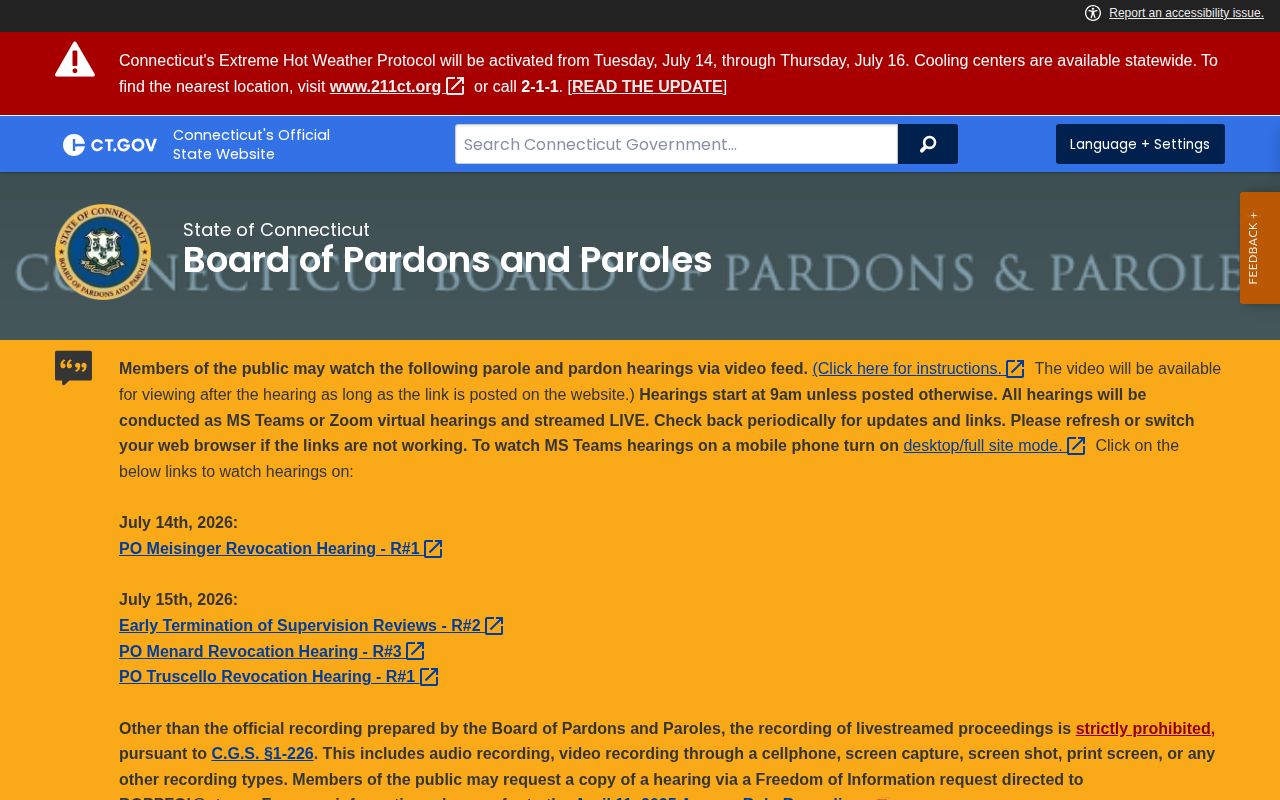
The calendar view is useful for locating a proceeding, but the official outcome and present supervision status still require the related Board, DOC, or court record.
BOPP prohibits recording or capturing a livestream under C.G.S. section 1-226. An official hearing copy may instead be requested through FOI at BOPPFOI@ct.gov. The research did not confirm a separate searchable decisions database, so the calendar, Board guidance, DOC status, court record, and an FOI request form the proper chain.
Hamden Release-to-Community Structure
Connecticut's correctional model is statewide. That matters in Hamden because the municipal police holding facility is not a county jail with its own parole unit. Once a person enters the Connecticut correctional path, DOC has responsibility for incarceration, reentry, and supervision of the return to the community. BOPP makes parole decisions, while DOC Parole and Community Services carries out community oversight.
This structure also explains why the release record and the supervision record may sit in different places. Hamden Police can document the local arrest or station release. The court can show probation or the sentence. DOC can show correctional status and dates. BOPP can show hearing context and parole action. A sound check follows that chain instead of looking for a nonexistent Hamden County parole roster.
The Connecticut DOC home page is the statewide starting point for correctional services and reentry information. Its role continues after a person leaves a prison building if parole or another DOC community status applies.
Note: Connecticut unified county jails and state prisons, so local release questions often move quickly from Hamden records to statewide systems.
Hamden Release IDs and Property
Identification papers can remain a practical issue after a Connecticut release. United Way 211 reports that personal identification held after incarceration stays secured at DOC Central Office for two years. When more than 30 days have passed since release, the researched route is the DOC Central Office Reentry Services Unit at 860-692-7869.
This contact is separate from parole verification. It helps locate identity documents retained through the correctional process. A person seeking property from a Hamden Police holding event should use the police department's own records or property channel, while documents retained after DOC incarceration follow the state reentry route.
The source details are available through 211 Connecticut's identification retrieval information. Keeping the two systems distinct prevents a local station question from being sent to a state office without cause.
Hamden Supervision Discharge Records
Supervision ends through an official event, not through the mere passage of an expected date. BOPP has authority under C.G.S. section 54-124a to set conditions, revoke or rescind parole or special parole, discharge parolees, and terminate special parole. A court controls the completion, modification, or revocation of ordinary probation.
For a parole discharge, check current DOC status, Board information, and the official record. For probation, use the Judicial Branch docket and clerk or probation contact tied to the case. Connecticut public-record law supports requests to the agency that holds the record, subject to exemptions and limits. Ask for the precise supervision discharge, termination, or final disposition record rather than a broad arrest file.
The requested record should include enough detail to distinguish a completed term from a custody change. Useful identifiers include the person's full name, date of birth, DOC inmate number when known, court docket number, type of supervision, and the date range at issue. Send a parole-record request to the Board or DOC office that owns the record. Send a probation disposition question to the Judicial Branch source tied to the case.
Public access can still be limited. Connecticut records law allows exemptions and redactions, and sealed, erased, juvenile, safety-sensitive, or restricted material may not appear in an ordinary search. A narrow request for the final action is more likely to reach the correct file than a broad demand for every note made during supervision.
A record that says the person left a facility only proves a custody movement. Full discharge means the relevant correctional or court authority has ended the term. That distinction is the final step in verifying Hamden County post-release supervision.