
Hamden Projected vs Actual Release
“Projected release date” is the common search phrase. Connecticut DOC uses the field label “estimated release date,” alongside minimum release date and maximum release date. Those are sentence-computation or legal-date fields. They show what the current record calculates, not proof that a person left custody on that day.
An actual release is a completed custody event. It may be release to the community, parole, a court-ordered discharge, or a move into another authority's custody. A detainer can keep the person from returning home even when one sentence reaches a key date. The release record, custody status, and destination therefore matter as much as the date.
A pretrial person at the Hamden Police holding facility or New Haven Correctional Center may have no projected date at all. “Accused” or “unsentenced” status points to bond and court action, not a completed sentence calculation.
Find a Hamden Projected Release Date
The correct route starts with the source of custody. Hamden has a municipal police holding facility, not a county sheriff jail with a release-date portal. Connecticut also operates a unified DOC system. A person who moved beyond the police station may be held or sentenced in a state correctional center even when the arrest began in Hamden.
- Identify the arrest, court, or DOC event. Use Hamden Police records for a station release and the court docket for bond or disposition.
- Open the CT DOC Inmate Information Search if DOC custody is possible. Use the inmate number alone when known, or begin with a few letters of the last name.
- Match the name, date of birth, inmate number, status, and location. Do not use a similar name as proof.
- Read “sentenced” versus “accused/unsentenced.” Sentence dates have a different meaning from pretrial custody.
- For a sentenced record, note the minimum, maximum, and estimated release dates. Also read any detainer field.
- Check the Judicial Branch docket for the sentence and later changes, then use BOPP material if parole is involved.
- When the public view is missing or stale, request the actual release or discharge record through DOC FOI or the agency that held the person.
The full custody-source sequence is available through the Hamden County released inmate lookup. It helps distinguish a local station release from DOC, federal, or immigration custody.
Note: A person absent from the DOC search is not automatically released; a court record, agency transfer, or restricted record may explain the result.
Hamden DOC Release-Date Fields
The Connecticut DOC search has four input fields: CT DOC inmate number, last name, first name, and date of birth. DOC advises using the inmate number alone when it is known. Without that number, a few letters of the last name can work better than filling every box. More data can be added only when the result set is too broad.
| Search or record field | How to read it |
|---|---|
| CT DOC inmate number | The strongest public search key when the number is confirmed. |
| Name and date of birth | Identity checks used to separate similar records. |
| Sentenced or accused | Shows whether sentence computation applies or the person remains unsentenced. |
| Current location | The reported DOC facility or correctional setting, not proof of future release. |
| Minimum release date | A legal or computed boundary shown in the DOC record. |
| Maximum release date | The current maximum-expiration date reported for the sentence. |
| Estimated release date | Connecticut's public label for the computed date many users call projected release. |
| Detainer | A hold that may block return to the community or change the next custodian. |
The public inventory can also include the controlling offense, admission date, sentencing date, minimum and maximum sentence, correctional history, discipline, and photograph. Not every field appears in every public result. Status may change before the online system finishes processing it.
Read the fields together. An estimated date attached to a sentenced record has meaning within DOC computation. The same date cannot be assumed for an accused or unsentenced person. A detainer can also explain why the expected date did not lead to release into Hamden.
When documenting the lookup, save the date checked as well as the displayed values. Correctional status can change after the search, and a later view may show a new location or computation. If two dates conflict, the current DOC record, court judgment, and agency response should be compared before deciding which event controls. A screenshot or note of an old estimate is useful context, but it does not replace the final release or discharge record.
Hamden Release-Date Credit Rules
A Connecticut sentence starts with the court's definite term, then DOC applies the credits and limits that legally fit that record. C.G.S. section 18-98d covers qualifying presentence confinement credit. It can include time in a correctional institution, community correctional center, police station, or courthouse lockup when bail was unavailable or denied. That makes it relevant to some Hamden custody that occurred before sentencing.
Section 18-98e authorizes earned risk reduction credit of up to five days per month for eligible sentenced inmates at the Commissioner's discretion. Listed offenses and certain offender categories are excluded. The credit cannot reduce a mandatory minimum term. It should not be described as automatic “good time” owed to every prisoner.
The official statute page shows the Connecticut-specific earned-credit framework used in a Hamden County sentence calculation.
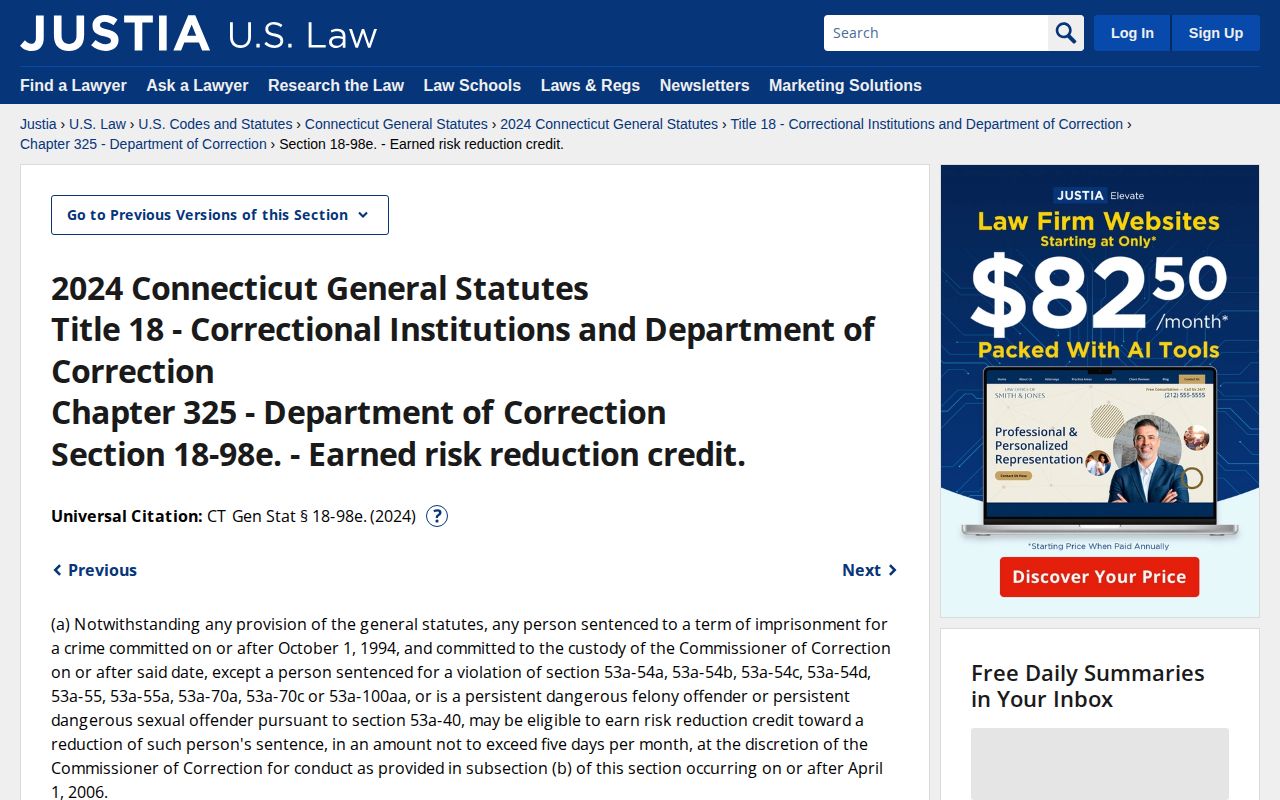
The statute is one layer of the computation, while the person's DOC record and court judgment supply the facts needed to apply it.
Older cases can involve section 18-7a good-conduct rules. They should be reviewed by sentence date and legal context rather than merged into the current risk-reduction framework.
Why Hamden Release Dates Change
Release-date fields reflect the facts and rules processed at that time. They can move when DOC corrects a credit, the court changes a sentence, or another authority places a hold. The effect is not always a later community release. Some events change the legal date, while others change only where the person goes next.
| Factor | Possible effect on the release path |
|---|---|
| Presentence credit | A correction or new calculation changes time credited before sentencing. |
| Earned risk reduction credit | Credit may be awarded, withheld, or lost under the governing rules. |
| Mandatory minimum | Earned credit cannot reduce the protected part of the term. |
| Detainer or hold | The sentence may reach a date, but another agency can take or retain custody. |
| Court action | A sentence may be imposed, corrected, modified, or vacated. |
| Parole decision | A grant, denial, continuance, rescission, or delay affects community-release timing. |
| Discipline or programs | Conduct and program factors can affect earned credit or parole review. |
A hospital move, federal transfer, or immigration transfer may also change the physical custody path without turning the DOC estimate into proof of release to the community.
Hamden Parole Eligibility Dates
Parole eligibility is not sentence discharge. C.G.S. section 54-125a governs parole for inmates serving eligible sentences longer than two years. For specified violent or force offenses, the statute requires service of at least 85 percent of the definite sentence before eligibility under that provision.
Section 54-125g provides a near-end parole route for some people within six months of maximum expiration. People in specified section 54-125a(b) categories must serve 95 percent before using that route. These thresholds mark when a decision may become possible. Neither percentage guarantees a grant or an exit on that day.
The BOPP parole FAQ explains that a “voted to parole” date is an on-or-after date. The Board may grant, deny, continue, or later revisit a case within its rules. Plan approval, a detainer, discipline, court action, or placement can affect the actual move.
Note: Eligibility opens a decision point; it does not erase the sentence or prove that release to the community occurred.
Hamden Release Computation Layers
Connecticut's three main layers should be read separately. Presentence confinement credit under section 18-98d addresses qualifying time before the sentence. Earned risk reduction credit under section 18-98e may reduce eligible time during the sentence, subject to exclusions and mandatory-minimum limits. Parole eligibility under section 54-125a controls when Board review or release authority may arise for the covered sentence.
The sequence is useful: court sentence, qualifying presentence credit, DOC sentence computation, eligible earned credit, parole eligibility, Board action, and actual release or discharge. A number at one step does not settle each later step. That is why Hamden County projected release date research needs both the court judgment and the live DOC record.
A person with accused or unsentenced status sits outside this sentenced computation. Bond, a promise to appear, arraignment, court conditions, dismissal, nolle, or transfer may control the next custody event. Hamden Police Records and the court are the correct sources for that local path.
Confirm a Hamden Release Date
Confirmation follows a hierarchy. First read CT DOC's estimated, minimum, and maximum release fields. Next compare the court docket for the sentence and disposition. Use BOPP hearing or decision context when parole matters. A VINE Inmate Check can add a participating custody-change alert, but it is not the official sentence computation.
For a Hamden police-station release, request the local custody or release record from Hamden Police Records. For a DOC release or discharge, use the CT DOC FOI office or the facility. Ask for the actual release event, destination, and status when those facts matter, rather than asking only whether an estimate once appeared.
The court remains essential when the date changed because of a new sentence, correction, dismissal, nolle, bond order, or other disposition. A docket can explain why a pretrial person left custody even though no DOC estimated date existed. It can also show a sentence change that the correctional search has not yet reflected.
When the release trail moves outside Connecticut DOC, switch systems. BOP records cover sentenced federal prisoners, and ICE uses its own detainee locator. A hospital move or transfer between authorities is not full discharge, even if the person no longer appears at the first facility.
If the person no longer appears online, the absence still needs proof. A fully discharged, restricted, sealed, misspelled, transferred, or federal record can all produce a failed search.